"LIVE! LIVE! LIVE! Life's a banquet, and most poor suckers are starving to death"
attributed to Mame Dennis
Showing posts with label Wine. Show all posts

Wednesday, April 21, 2010

Wine Blogging Wednesday: Gamay

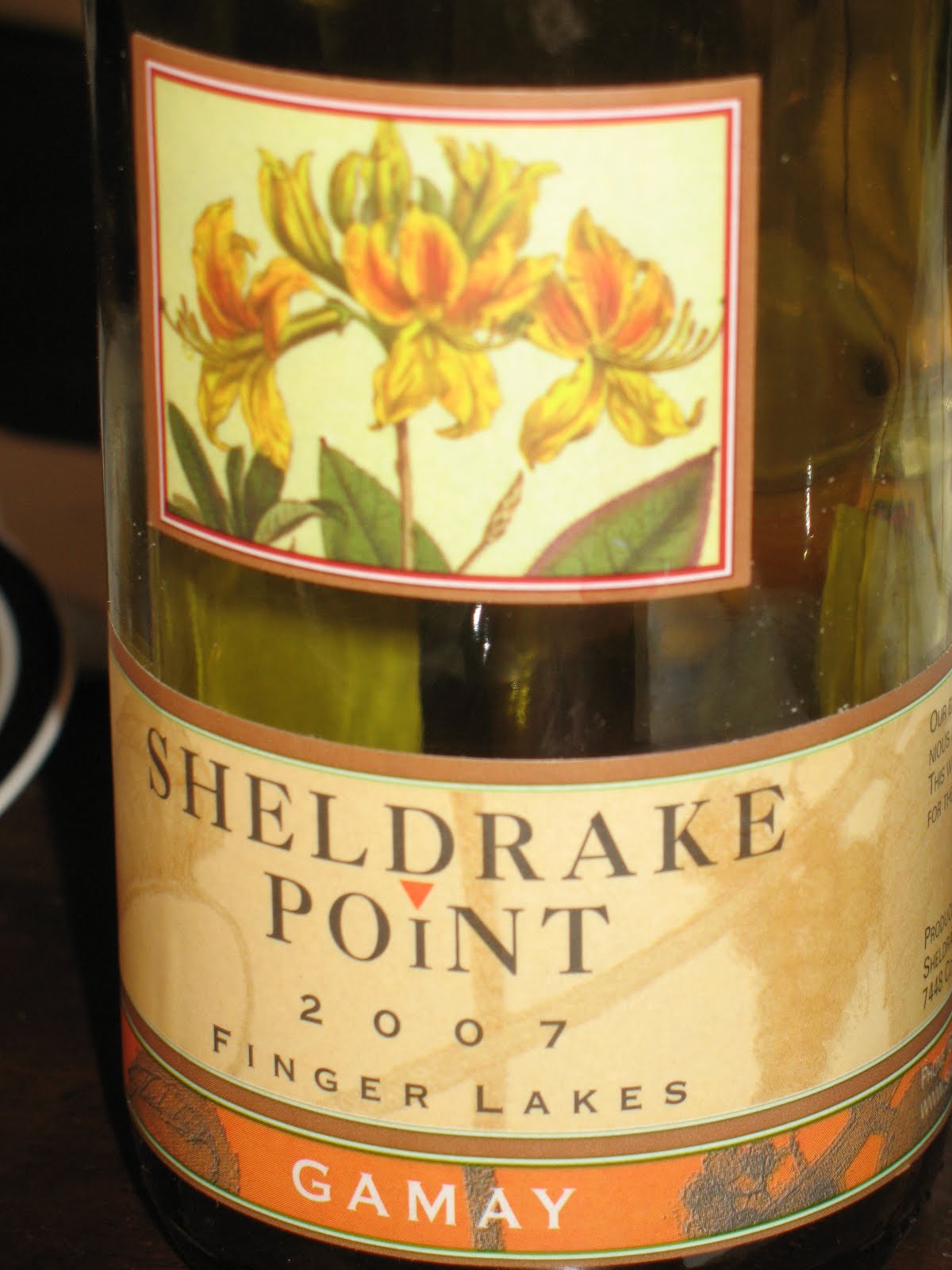
2007 Gamay
Sheldrake Point 
(Finger Lakes)
"An Estate wine produced entirely from Gamay Noir grapes grown in two blocks (about 3.3 acres) in our 44-acre vineyard located on the west shore of Cayuga Lake.
On October 5, 2007 5 tons of grapes were hand-harvested (22 Brix, 8.2 g/L Ta, 3.29 pH) then crushed and de-stemmed into a stainless steel tank. The wine was fermented on the skins (RB-2 yeast) with daily pump-overs. The fermentation temperature peaked at 91F.
The Gamay was pressed after seven days on the skins then racked into older, neutral French and American barrels. Malolactic fermentation finished by November 20, 2007. The Gamay spent six months in neutral barrels."

     I chilled the wine slightly for my first tasting last night, as this is how I understand it is traditionally served. This wine is ruby-colored, a beautiful, clear jewel-tone of medium intensity. The nose is floral, with aromas of white flowers, iris and violet which opened into red fruits, specifically red currant, with a hint of vanilla. The wine is light-bodied and dry with a tart acidity, which dominates the palate. There are notes of pomegranate, cranberry and under-ripe plum, with strawberry on the finish. More aromas and flavors were evident as the wine warmed up. I suspect the acidity of the wine would make it very food-friendly, so I am going to serve it with dinner tonight and see how that goes.

     The wine benefited from being open for a day, even though I Vacvin-ed it. Even served slightly chilled, it was more open and the red fruits much more evident on the nose. The acidity seemed to have mellowed, displaying softer cherry and (ripe) plum flavors with some nice, light spice reminiscent on the sandalwood on back of the palate.

     The wine was pleasant with the hodge-podge we had for dinner tonight: a little homemade margherita pizza made with some leftover whole wheat dough to start, and as well as the grilled mushrooms on the side. (I thought this would be good since the Gamay grape is related to Pinot Noir.) The best pairing was the roast pork slices that we warmed through on the grill. The fruit forwardness in this Gamay complemented the pork, and the acidity valiantly cut through the fattiness.

Thanks to http://drinkwhatyoulike.wordpress.com!

Thursday, December 17, 2009

A Flight of Rieslings Around The World: Tasting Notes & Reflection

The idea started when Kathy and I were wondering how Finger Lakes Rieslings compare with the traditional German ones. We should taste them and find out! Of course, it snowballed from there, and food pairings and Rieslings from other regions in the New World. We finally got together and had the event. We went a little overboard with both food and wine ("Doesn't make you a bad girl," as Pat would say), so it was a little overwhelming. Not only did we learn about the different Rieslings, but we enjoyed them.

We found the German Rieslings overall had a rich texture and relatively full body. Kathy did a great job picking out three bottles with different levels of sweetness. Honey was the flavor that stood out, to varying degrees in each. There were also the classic apple and pear flavors, more in baked or dried forms than fresh. However, all three German wines were well balanced.

The 2005 Peter Mertes Privatkelleri Spätlese (sweet, late harvest) was the prime example of this: very golden in color, creamy in texture and sweet honey and fruit on the tongue, but with a comparably clean finish. It paired surprisingly well with many of the foods, particularly the apple and onion sausages.

The 2008 Pölka Dot Riesling (semi-dry/semi-sweet) was a lighter, more lively (if less complex) take on these flavors. Honey and baked apple were still prominent. It reminded us a bit of Lamoreaux's Semi-Dry Riesling. It is clear from the flashy, contemporary look of the bottle that this wine is designed to be a crowd pleaser, and it was exactly that. It turned out to be one of the favorites of the evening. This wine is ideal for quaffing, but also paired nicely with the foods we sampled it with.

The 2007 Franz Wilh. Langguth Erben Kabinett (dry) was a delicate, "calm" wine. The dry, freshness worked with the cheeses, particularly the brie, and was a pleasant palate cleanser between tastes.  However, it's mild flavors were easily overpowered by most of the food pairings.


The 2007 Snap Dragon Riesling (semi-dry/semi-sweet) from California fell somewhere between the Old and New World wines, and shared many qualities with the Pölka Dot (comparable sweetness.) This must be the type of Rieslings being made for the American market. There were strong honey notes on the nose, though less on the palate with a slight spiciness on the finish. It paired well with foods as diverse as wasabi peas to sweet potato gratinée.

2008 Chateau Ste Michelle Riesling (dry) from Washington's Columbia Valley had a delightful effervescence and crisp notes of citrus and perhaps honeydew. This dry Riesling was also great with the cheeses. I especially liked it with the Raclette.

While I lived in London, I developed a strong affinity for the wine from New Zealand, so I really wanted to include one in this tasting. I searched high and low, and was thrilled to find the 2007 Kim Crawford Dry Riesling. It was quite bracing and austere, with a crisp minerality (almost a bit briny) and flavors of lime and all things green, but little of the fruit we noticed in the other Rieslings. The best pairing was with the (green) wasabi peas, and I bet it would be a great wine with sushi (or oysters!)

Of course we were already familiar with the Finger Lakes Rieslings, but it was interesting to have them as a basis for comparison. Standing Stone's 2008 Riesling was awarded 89 points in Wine Spectators, and I had a bottle leftover from Thanksgiving (when everyone decided to drink red.) It was most similar to the Washington and New Zealand wines, light and crisp. It was slightly effervescent and had notably more fruit flavors (apple, pear, citrus.)

The Pear & Fennel Flatbread was designed by Red Newt's Deb Whiting to pair the 2008 Lamoreaux Landing Red Oak Vineyard Riesling. It was a good pairing, but the peppery arugula overpowered the wine a bit. I think I just put too much on. Next time, I'll use milder, baby arugula. After tasting Rieslings from around the world and coming back home to the Finger Lakes, I tasted this wine with a new palate and persepctive. This wine, made from the first harvest from these particular vines, is light and friendly. Lush flavors of apple and pear stand out, with notes of honey, as a nod to the grape's German roots.

The evening was rounded out with a special treat: apple turnovers with 2007 Lamoreaux Landing Riesling Ice, perhaps the best pairing of all-- but how could you go wrong?


We look forward to doing tasting evenings like this again, exploring other regions and varietals. I learned a lot from putting together this evening. In future, we will stick to fewer wines (3-5). This will make it easier to keep track of each one, and to keep them colder (if necessary). Having a dedicated glass for each wine will also help with this, as will place mats giving the particulars of each wine. To better evaluate the wines and their food pairings, we have to give the evening more structure. (Not arriving hungry and thirsty is a good start!) First, all the wines should be tasted on their own. Then the food is introduced slowly, allowing for each wine to be sampled with each dish. This will also keep us from predetermining which wine we think should go with the food, and allow for those wonderfully delicious surprises. What fun!
Tuesday, December 15, 2009

A Flight of Rieslings Around The World: Menu


2007 Franz Wilh. Langguth Erben Kabinett (Germany)
2008 Pölka Dot Riesling (Riesling, Pfalz)
2005 Spätlese (Germany, Rheinhessen)
2007 Kim Crawford Dry Riesling (New Zealand, Marlborough)
2007 Snap Dragon Riesling (USA, California)
2008 Chateau Ste Michelle Riesling (USA, Washington, Columbia Valley)
2008 Lamoreaux Landing Red Oak Vineyard Riesling
(USA, New York, Finger Lakes)
2008 Standing Stone Riesling (USA, New York, Finger Lakes)
2007 Lamoreaux Landing Riesling Ice (USA, New York, Finger Lakes)


Wasabi Peas
Goldfish
Wine crackers

Pear, Fennel & Arugula Flatbread

Cheeseboard
Triple Crême Goat Brie (Canada)
Uniekaas Reserve Gouda (Holland)
Emmi Raclette (Switzerland)
Manchego (Spain)
Apple Slices
Almonds & Walnuts
Stoneground Wheat & Water Crackers
Crusty Bread

Apple & Onion Sausages with Riesling Mustard

Seared Scallops

Sweet Potato Gratinee

Thai Pumpkin Curry

Apple Turnovers
Coffee


Monday, December 07, 2009

A week with no shopping: Inspiration & Innovation

I have extended this challenge for myself beyond the initial week. I did shop for Thanksgiving, and was successful sticking to a specific list. We have also bought necessary perishables (ie milk), but the bulk of our meals have been clearing out the fridge, freezer and pantry. What a lot of food I have accumulated since we moved in June! This challenge has put me in a frugal, efficient mindset, and the limitations have inspired me.

Last week, we were eating Thanksgiving leftovers like everyone else, but our surplus was pork. On Wednesday, I made an abundant batch of silky pork stock. For dinner, I turned it into Hot & Sour soup accompanied by pork, scallion & ginger potstickers. We do have frozen potstickers from Trader Joe's in the freezer, but I made the filling for these myself, wrapping them wonton wrappers that I've had in the freezer for ages.
I used Barbara Kafka's recipe for Hot & Sour soup, and the first night I was disappointed with the result. I was surprised about this because her book Soup, a way of life is one of my favorites. I was relieved the next day when the leftovers were wonderful. Now I know to make this soup a day ahead.

Thursday, I warmed some shredded pork in a saute pan and added a small tin of green hatch chiles (Trader Joe's). Then I stirred in a tablespoon or two of flour and some milk to make a white sauce, not forgetting plenty of shredded cheese. We had this in corn tortillas as a lovely, light dinner. The next morning, I fried two eggs and ate them with this pork and green chile mixture and a warmed tortilla. Wonderful as well. Sorry, no photos. It's not the most picturesque meal, but it doesn't make it any less tasty.

The success of Thursday's meal and an open package of tortillas unfinished led me to create a variation on Friday. No more green chiles, so I used chipotles in adobo. I always have a couple cans of these smoked jalapeños in my pantry. I love the concentrated flavor kick they give this sort of dish, or to a vegetable soup. Only one pepper is necessary with a spoonful or two of adobo sauce. I chopped up the pepper (maybe I should have deseeded it) and mixed it in with the pork. At this point, I felt the mixture needed more moisture, as well as something to dilute the spice a bit. I wanted to do something different from the previous day's white sauce. The pork was also starting to stick to the pan a bit. When Pat does the dishes, he often teases that I should be a chemist at a glue factory because he doesn't know how I make everything stick so well to the pan. Wanting to avoid further taunting, I searched for something to deglaze the pan. This is when I saw the magnum of Malbec (Marcus James) amongst our stock of everyday wines. This wine is bold enough to stand up to the spicy pepper, and has an earthy character that will complement the smokiness. I couldn't believe how well this combination worked, though the mixture was still too spicy when served in a corn tortilla. Adding sour cream and shredded cheese helped some, as did heating up a can of refried beans to serve plain on the side, but I think it would be best served it over rice.
I want to explore the connection of Malbec and chipotle though. There's something good here. Hooray!

Friday, October 16, 2009

Soup of the Week: French Onion


      When I lived in Manhattan, I often ordered French onion soup as a late night snack at a diner or bistro and justified paying five or six dollars for it by telling myself it wasn't the type of thing you could make at home. In Paris, I ordered it everywhere I ate, savoring each variation. It is a perfect light meal during the week, especially when rounded out by a nice salad and a glass of red wine. We recently enjoyed this soup with this delightful Bordeaux blend (pictured at right). The French are great at making easy drinking table wines, and this one is a prime example, dry and subtle, and a bargain at $14 per magnum.
     Last winter I started a project to demystifying French Onion soup, so I could make it for myself (and maybe a lucky friend or two) just how I wanted, whenever I wanted. I bought myself some oven proof crocks and read up on all the different recipes out there. The soup that I make right now is based on Anthony Bourdain's recipe from Les Halles.
     Not a lot of fancy ingredients are required to make French onion soup. That is one of the things I love about it: onions, stock, bread, cheese and seasonings. Blissfully simple!
I usually splurge on a nice cheese, since you don't use a whole lot of it and I feel that it makes a big difference. Gruyere is my favorite so far, but you can really use whichever cheese (or blend of cheeses) you like, or have in the fridge. Swiss, provolone, mozzarella, gouda...the sky's the limit!
This dish does require patience. I've broken it down in my head to several steps, which gives me more flexibility and allows me to make this wonderful soup more often:

Caramelized onions. Our friend, Frankie, gave us some of his country bacon. I couldn't bring myself to waste the bacon grease that was left over after cooking it, so I sliced up some onions and let them cook in the grease at a low heat. This is the first place patience comes in. It can take some time for onions to get as rich, brown and melty as you want them. Watch them carefully because you don't want the onions to burn. The process is very satisfying, and smells just wonderful, but I don't always have the time to do it.
     Luckily, I have learned that you can caramelize onions in a crock pot. It usually takes 10-12 onions, sliced, to fill my crockpot, which I then drizzle generously with olive oil (sometimes I use a knob of butter as well, or instead) and sprinkle the top with dried thyme and maybe throw in a bay leaf. This doesn't achieve exactly the same result as caramelizing in a pan, but it saves a lot of time. The caramelized onions keep well in the fridge. I've also read that you can freeze them, but I haven't tried that yet (ie I always eat them all before they get to the freezer.) There are lots of other excellent uses for caramelized onions, such as a topping for a burger or steak or in an omelette.

     Once the onions are caramelized (or onions that you've pre-caramelized are warmed though), you can add a splash of port, sherry, balsamic vinegar, red wine, white wine, or any combination thereof. (Maybe a some of what you're planning to serve with the soup, or some of what you've been drinking while you caramelize the onions.) Recipes vary here, so it's up to you. For me, it depends on my mood and the levels of the bottles in my cupboard.
Stock. Next, add the stock to the pan with the onions. Simmer the stock with the onions to allow the flavors to concentrate, tasting as you go. Ladle soup into oven proof crocks. Put a slice of toasted bread and some cheese at the bottom of the the bowl before adding the soup for a great extra surprise.
Both beef and chicken stock (or a combination of the two) work well in this soup. Stock does merit (and will get) its own post(s), but long story short: the better the stock, the better the soup. This rule especially applies with French Onion. Making stock also takes patience, but there really is no substitute. You can make your stock ahead of time and keep it in the fridge, or freeze it, so it's ready when you want to make the soup.  Your crockpot can also come in handy preparing the stock.

Assembling the soup. First, preheat your broiler. Slice up a baguette or whatever bread you'd like, toast one slice per serving and float on the soup in the crock. This is an excellent use for day old bread. I had great success once using a leftover olive roll. Grate the cheese, and generously top the crouton with this. Make sure to sprinkle some over the edge. It will form a tasty crust on the crock. The crouton and cheese make this soup. I can't think of another dish where the garnish is so important, but I do know that melted cheese makes anything taste better.

Place the crocks on a baking sheet and broil on high for a 5-7 minutes, keeping a close eye. By this time, your house will smell delicious and you'll be getting your spoon ready to dig in.
Allow to cool before devouring.


Friday, October 09, 2009

Smoked Pork Chops with Fresh Peach Chutney


      Pat and I celebrated the change of seasons with this meal, a serendipitous combination of summer and fall ingredients. Harvest is upon us. The Finger Lakes grapes are being picked and crushed. Our friend, Frankie, had his pig slaughtered, and he shared a couple smoked pork chops and some country bacon with us. I was eager to taste them.

     Despite the change of weather and appetites, my garden is still producing tomatoes, and even provided a couple nasturtiums to brighten the plate. A quick Google gave me ideas on putting together a chutney to smother the chops with, using up the last of the summer's peaches. In a small saucepan on low to medium heat, I melted brown sugar in apple cider vinegar. Then, I added grated ginger and carefully minced hot pepper (courtesy of our friend Fred's garden), tasting all the while to test for balance of flavors. Next, I tossed in half a handful of raisins, which soon plumped up. Lastly, I stirred in chunks of peeled peaches. The chutney was then simmered until it reached the desired consistency, and allowed to cool to room temperature before spooning over the meat.

      Frankie's instructions regarding the pork chops were: put these in a pan with some water and a little butter. They are already cooked (via smoking) so they just have to be warmed through. The truly wonderful thing about this pork is that has no water added. This provides a superior texture and flavor to the meat. It also doesn't hurt to know that the pig was raised down the road, fattened on kitchen scraps and garden refuse.

We paired the meal with one of my favorite wines of the summer, Lamoreaux Landing's 2008 Red Oak Vineyard Riesling. All the grapes in this wine come from a four acre vineyard in southern Seneca County. The vines in this parcel are very young and 2008 was the first harvest from the Red Oak Vineyard. The result was an off dry riesling, which is incredibly fragrant on the nose with nice orchard fruit and honeysuckle notes. (Yes, I have my tasting room speech down. What can I say? I work at Lamoreaux because I love the wine.)
    We are squeezing the last drops out of summer, but welcome the coziness and spice that fall promises.


Monday, September 28, 2009

Bringing Jean Georges home


       The sweet and sour jus served with the snapper at Jean Georges bewitched me. I couldn't get it out of my head. Aside from butter, I couldn't put my finger on the ingredients I was tasting. I only knew the rich combination of flavors was intoxicating. Of course, upon reading the recipe the secret ingredient was obvious-- mushrooms!

     I was mainly interested in recreating the sauce, so I decided to concentrate on that, leaving the nut and seed crusting for next time. The trick was browning the butter slowly. Next time, I'll clarify the butter and keep a closer eye on it so it doesn't go quite so brown.

This is a totally different type of cooking from what I'm used to, giving you less freedom to multitask and requiring more careful attention to each step. It is an useful exercise in timing and discipline. I used sherry vinegar in place of the Banyuls vinegar. For the summer vegetables which swim in the buttery sauce, I used the last few cherry tomatoes from my garden, along with baby red potatoes and yellow pearl onions for some variety of color. (The mushrooms that were strained out of the sauce made an awesome addition to my scrambled eggs the next morning.)

I wasn't thrilled with the red snapper at Wegman's that day, so I chose some much nicer looking haddock fillets which were a couple dollars less per pound, which I pan fried simply and served over top.


The flavor was as I remembered it. Patrick and I enjoyed it outside (while we can!), watching another one of Seneca Lake's legendary sunsets. We paired it with a bottle of Lamoreaux Landing's 2007 Reserve Chardonnay, a beautiful complement. Butter all around!